Monthly Mindbenders: The Ladybug's Clock Walk
Monthly puzzles to challenge your mind, from Peter Winkler and 3Blue1Brown's Grant Sanderson.
The series
I've decided to follow along with the MoMath Monthly Mindbenders, a series of puzzles curated by Peter Winkler and shared by Grant Sanderson (of 3Blue1Brown fame). Each month, I'll be attempting to solve these and documenting my thought process here.
January's puzzle (2026)
The first puzzle of the year is a probability question about a classic random walk:
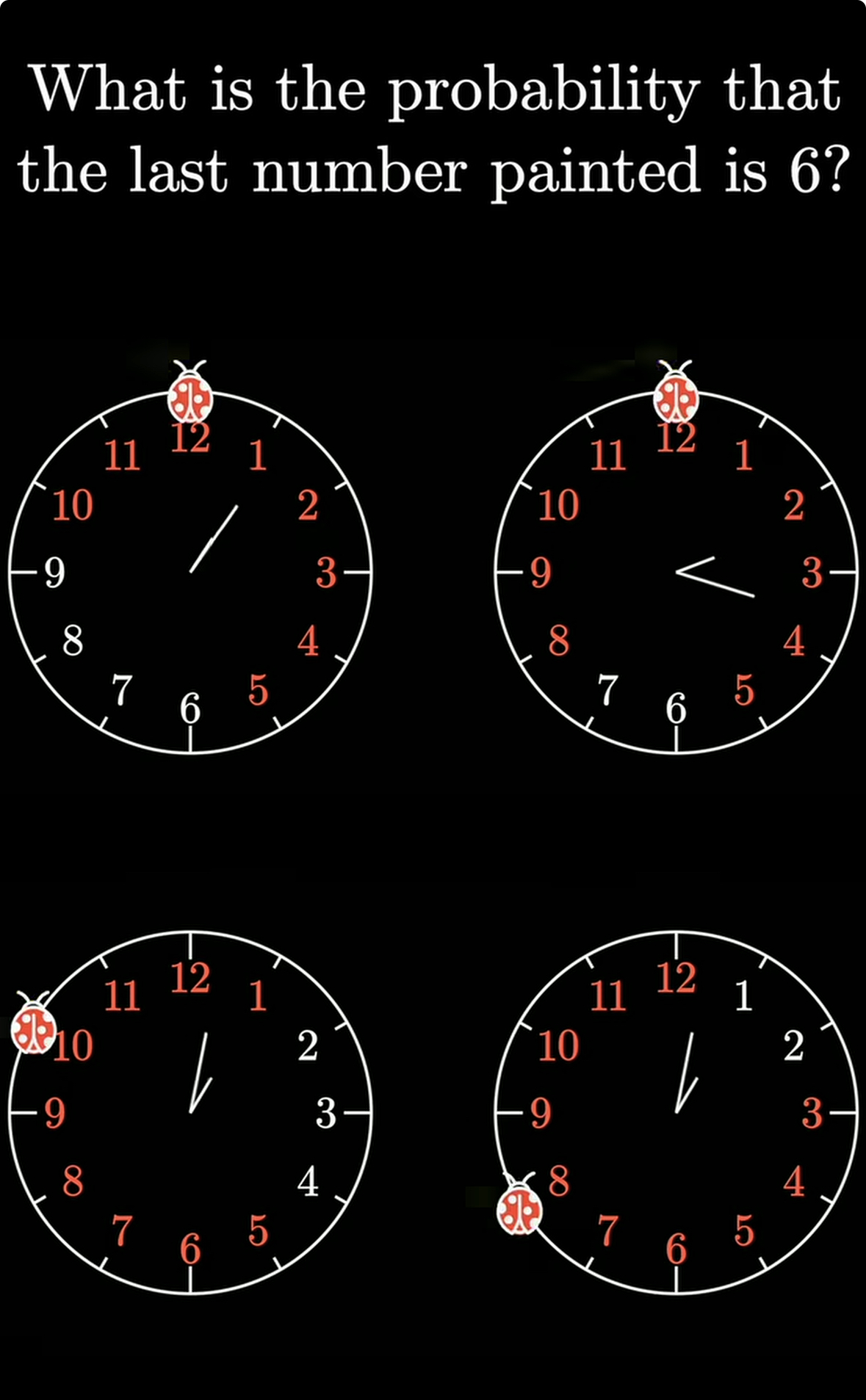
A ladybug alights on the 12 of a cuckoo clock. Whenever the clock strikes, she moves randomly to a neighboring number. For example, the first time, she moves to the 1 or the 11 with equal probability.
Suppose the ladybug continues this process until she has been to all of the numbers at least once. What is the probability that the last new number she visits is 6?
My attempt
Symmetry and intuition
Let $P(x)$ be the probability that number $x$ is the last new number the ladybug visits.
First thing, the clock has a beautiful symmetry. The problem doesn't change if we flip the clock horizontally. The probability of 1 being the last number visited must be the same as 11. This can be proved trivially as well, but I going to rest my argument here, because I am no longer have to turn up a submission to judge anymore xD
$$P(x) = P(12-x)$$
So, $P(1) = P(11)$, $P(2) = P(10)$, and so on.
Connecting other pieces
From 12, her first step is equally likely to be 11 or 1, which means:
$$P(6) = \frac{1}{2} P(6 \mid \text{first step to } 11) + \frac{1}{2} P(6 \mid \text{first step to } 1)$$
Take the first bit, $P(6 \mid \text{first step to } 11)$.
This becomes that we start at 11, but the last number we visit is 6. This situation is rotationally equivalent to $P(7)$
$$P(6 \mid \text{first step to } 11) = P(7)$$
Similarly,
$$P(6 \mid \text{first step to } 1) = P(5)$$
$$ => P(6) = \frac{P(7) + P(5)}{2}$$
We saw earlier, $P(7) = P(5)$
$$ => P(6) = P(5)$$
If we extend this,
$$P(1) = P(2) = .... = P(11)$$
So the probability is just:
$$\mathbf{\frac{1}{11}}$$
It turns out 6 isn't special at all. Every number except the start (12) is equally likely to be the last new one.